Tuesday, February 24, 2009

The votes are in...

via Interior Design Show Toronto 2009 Blog...
Material Inspires Winning Window:

It's been a couple of weeks since the show and believe it or not, the IDS team is already busy working on IDS 2010! We would like to thank everyone who attended the show, and say a special thank you to those who shared their photos on Flickr or our Facebook Fan Page, tweeted about what they saw, or participated in our various contests...

One of our favourite IDS 09 contests was our 2nd annual Window Contest, where we challenged retailers to create a window display based on the theme of our show. Since INSPIRATION was this year's theme participating stores designed their windows to creatively convey an inspirational design. We were pleasantly surprised to see how these stores rose to the task at hand and also how many of you took the time to vote online!

We're excited to announce that this year's Window Contest winner is Relative Space/Floorworks, who was also an exhibitor in the Luxe Home feature area at this year's show. Located in the Upper Annex on Dupont Street, Relative Space/Floorworks' showroom used to be an old car garage space that has been transformed into a bright, open concept store. They carry a broad range of products for the home; from modern contemporary furnishings such as Porro, Living Divani, high end flooring, accessories and recently added to the repertoire, Schiffini kitchens.

What is particularly unique about Relative Space/Floorworks' approach to their window displays is that they are designed by artists, either emerging design students (from various design schools such as OCAD) or by established artists. The changing of the windows on the last weekend of every third month is a highly anticipated event by the neighbourhood and art enthusiasts alike.

Relative Space/Floorworks
' winning window was created by Susan Rowe Harrison who called this particular installation Inflorescence. When asked about her inspiration behind the work, Ms. Harrison told us, "I wanted to engage the physical properties of space and architecture with works that explore form and content (or, form versus content) in a personal way using a mundane, commercial material—sign vinyl. At Floorworks, I started with a natural form—a group of flower heads—taken to an abstract extreme. I wanted the work to transcend its material to provide the instant impact of a huge abstract painting, which at the same time subverts the slow and labor-intensive process of hand-cutting large rolls of vinyl and applying it to the wall."

Congratulations to Relative Space/Floorworks and Susan! You can find photos of the other participating store windows in our Flickr album.

Wednesday, February 18, 2009

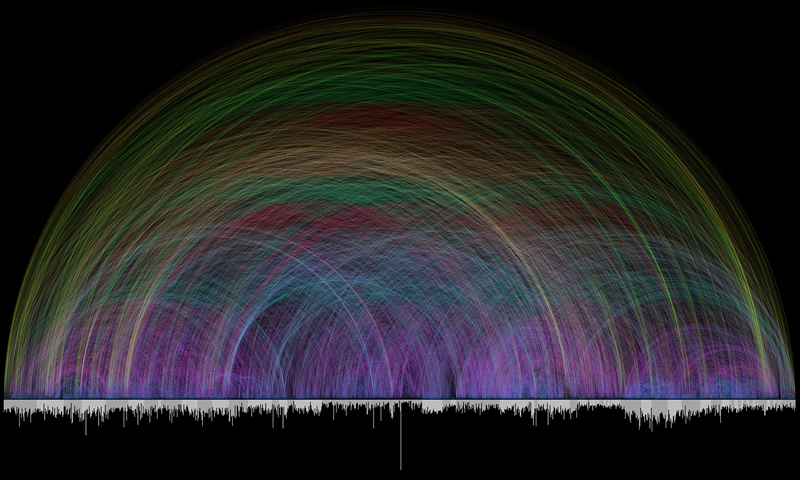
Visualizing the Bible

by way of flavorwire...


This is a really amazing set of projects by Chris Harrison on visualization (of data sets). It is amazing how information can be so beautiful...and in a way it helps us "see" the magnitude of a topic or issue.

Reblog this post [with Zemanta]

Tuesday, February 10, 2009

Saturday, February 07, 2009

Friday, February 06, 2009

Thursday, February 05, 2009

Michael Bierut: 26 Years, 85 Notebooks


via Kim Werker:

I never thought that I would follow so many designers but something has happened to my thinking and I think that this post from Michael Bierut goes for anyone who takes notes/makes drawings...

Kim Werker is my hero of the day after listening to her on Sister Diane's recent podcast and looking at her booklist on Amazon.com


Reblog this post [with Zemanta]

Wednesday, February 04, 2009

A very quiet Bunhill Fields (cemetery of alternative thinkers in the City)


London on Monday taken by Si Harper, a friend of ours...

via DailyDose

FILM
O, National Film Board of Canada
Hundreds of free cinema classics hit the Web
Begone Dull Care Watching brilliant films online for free is a bandwagon we're happy to hop on, and today's addition is a doozy. The National Film Board of Canada just launched a new site that offers high-quality streams of its award-winning pictures and a plethora of supporting content.

The NFB nurtures the world's best animation. The Cat Came Back (1988) is a hilarious, Oscar-nominated adaptation of the classic popular song; and Begone Dull Care (1949) is a groundbreaking experimental work, painted directly on film, that interprets the vivid sounds of the Oscar Peterson Trio.

Watch an expert's playlist. The site features picks from a host of luminaries. Director Gil Cardinal showcases aboriginal filmmaking, while the NFB's chief archivist highlights the best of the 1960s.

Kill time, not brain cells. While the archive features standard searches (genre, year, director, title, keyword), films can also be sorted by length, making it easy to fill downtime with worthy fare.

Explore the site, check out some expert playlists, and browse the NFB's online store.

- Eli Dvorkin

Tuesday, February 03, 2009

Wowee!

japan - fujimori’s architecture and ROJO
venue: pavilion at giardini
commissioner: fujimori terunobu
deputy commissioners: okabe miki, omori hiroshi

two art movements have recently gained a lot of attention in japan
- the architecture of terunobu fujimori and ROJO (on the roadway).


‘nira house’ - leek house by terunobu fujimori and nobumichi ohshima, 1997

The only "leek-y" roof that you will find equally beautiful and useful:


‘ichiya-tei’ - one-night teahouse by terunobu fujimori
and nobumichi ohshima, 2003


model ‘takasugi-an’ by terunobu fujimori, 2006

Reblog this post [with Zemanta]

Friday, January 30, 2009

Save the Word

via Makeuseof...
There are some great ideas for saving archaic words...if you use text in your work...

Thursday, January 29, 2009

Guardian People's Choice 1000 Books Before You Die

via Boldtype
1000 novels everyone must read
Choosing 1000 novels to read before you die
We didn't want a list of 'greatest novels', or a list of 'favourite novels', but what have we left off our list of 1000 novels everyone must read?

By Philip Oltermann

How many novels did you manage to read over Christmas? I usually pack about six books, then barely open a third of them. This year, I managed two. One, though, was for work (very long and quite bad) and only one of them for pleasure (very short and very good). So let's say one: reading one novel per month definitely sounds like a manageable project. If over the course of an entire year you read one novel a month, I'd guess that you could probably fit in one extra as well (perhaps during the summer holidays). Embark on this 13-novels-per-year schedule when you're eight (with, say, Asterix the Gaul or Black Beauty) and stick to it until you're 85 (finishing perhaps with Tolstoy's War and Peace or Thomas Bernhard's Extinction), you'd have read a thousand novels in a lifetime. Easy, isn't it?

I'm exaggerating to make a point. A thousand novels might sound like an awful lot of pages and a dizzying number of words, but the idea behind this series was always to come up with a list that was, in its own way, realistic. Not necessarily in the sense that you might be able to work your way through all of our picks in a month, but in the sense that it can inspire and guide book-lovers of all tastes and ages. The temptation, when coming up with projects such as these, is to plump with much bravado for either an elitist or a populist approach. We could have listed the worthy but dull "1000 greatest novels of all time", including a few more recherché Victorian epics and forgotten gems of late Mexican vanguardist modernism. Or we could have come up with a fun but shallow list of "1000 most popular novels of all time", inevitably adding Paolo Coelho's The Alchemist and Dan Brown's Da Vinci Code. Neither of these approaches felt quite right. It would have meant either excluding those novels we had read but felt we shouldn't, or those we felt we should read but hadn't.

In the end we came up with a solution that, we hoped, allowed room for both the Mrs Dalloways and Bridget Joneses of this world. Rather than dividing up our series alphabetically or by decade, we invented our own seven genre categories, each of which highlights a different aspect of the novel. First was Love, which prioritised writers with a gift for psychological verisimilitude, such as Austen, Fitzgerald, Flaubert, James, Hardy and Kundera. It was followed by Crime, where plot and suspense were king, and those often sidelined as "genre fiction" — Crichton, King or Rendell — were given credit for their craft.

Comedy tied together "funny" comics and comics more philosophical, ranging from Amis to Wodehouse via Gogol and Mitford. The next category, Family and Self, was tailored to the cusp between 19th century realism and 20th century modernism, comprising both sweeping family sagas and mumbled interior monologues, while State of the Nation dealt mainly with novelists who had a social vision and a political message: Dickens, Dostoyevsky and Zola came into their own. A bold and vivid imagination marked out the titles in Science Fiction and Fantasy, including classics such as Do Androids Dream of Electric Sheep, The Lord of the Rings and Frankenstein. The series concludes with War and Travel, where a narrative gift for evoking the excitement of a journey and the specifics of a place brought together popular classics such as Robert Louis Stevenson's Treasure Island and more recent works such as WG Sebald's Austerlitz.

None of the these are "hard" categories — which is to say that we couldn't resist sticking a few likely books in unlikely places. Zola's Therese Raquin and Steinbeck's Of Mice and Men aren't obvious contenders for Crime in the same way that books from Edgar Wallace and Henning Mankell are, but it's illuminating to consider them as investigations into the same subject matter.

Naturally, the process of coming up with this list wasn't always easy. To start with, the Guardian Review's editorial team came up with a list of almost 1500 titles. Over a lengthy lunchtime session, the longlist was then whittled down to a shortlist of a thousand. A crack team of our leading critics and experts tried to save us from embarrassment, spotting inaccuracies and oversights.

Certain books triggered particularly heated debates. Was Evelyn Waugh's Scoop a comedy, faux war reportage or a satire on the state of 1930s Britain? Is The Trial an existential investigation of the self, a proto-sci-fi yarn or a philosophical comedy?

But the most interesting thing about any list of books is always the titles that have been left off. We'd like to hear all your suggestions of crucial books that haven't made it onto our list. Tell us your nominations, and explain why they should be on the list in less than 150 words — you can also email them to review@guardian.co.uk or post them to The Guardian, Kings Place, 90 York Way, London N1 9GU, by 4 February. We'll publish a list of readers' recommendations in Review next month.


Reblog this post [with Zemanta]

Artist Press Releases

While looking for help in writing an email, I stumbled over advice from ArtFagCity on how to put together together a press release/kit.

Friday, January 23, 2009

I really love butterflies


I will definitely try to record this! More on the monarch watch blog

Aerial Photos from Si

At visually beautiful though disheartening photos

Europa Film Treasures Online via Daily Dose

I have just watched a couple of the films on Europa Film Treasures site and could easily spend the day watching this online clearing house of important European films. Some are simply weird and other weirdly fascinating but a nice way to take a 5-10 minute break from what you are working on...Pretty cool that you can travel these little movies from your desk rather than having to wait for them to be shown at your local art house cinema.

Symphonie Diagonal 1925
or Programme Nadar - 1896 or La Joie de Vivre 1934

Wednesday, January 21, 2009

Wednesday, January 14, 2009

Notebook made of thread

By way of supernaturale...

I can't quite pinpoint why I find this note book so poignant?

Red Hook Kiosk Competition


An organic take...


Wish we could see the Toronto street food entries!

The making of Forever at the V&A


The Making of Forever / Victoria & Albert Museum from Universal Everything on Vimeo.

Tuesday, January 13, 2009

Hack your brain

By way of Flavorpill
or, How to hallucinate with ping-pong balls and a radio
Text by Johan Lehrer, graphics by Javier Zarracina


DO YOU EVER want to change the way you see the world? Wouldn't it be fun to hallucinate on your lunch break? Although we typically associate such phenomena with powerful drugs like LSD or mescaline, it's easy to fling open the doors of perception without them: All it takes is a basic understanding of how the mind works.

The first thing to know is that the mind isn't a mirror, or even a passive observer of reality. Much of what we think of as being out there actually comes from in here, and is a byproduct of how the brain processes sensation. In recent years scientists have come up with a number of simple tricks that expose the artifice of our senses, so that we end up perceiving what we know isn't real - tweaking the cortex to produce something uncannily like hallucinations. Perhaps we hear the voice of someone who is no longer alive, or feel as if our nose is suddenly 3 feet long.